Ever more exhibition organisers, agencies and brands are looking for ways to reduce the environmental footprint of their stands. One initiative gaining traction across Europe is Better Stands, a certification scheme that rates how reusable an exhibition stand actually is.
Van Straaten is not a member of Better Stands, but we support the initiative as a print partner. A large part of the reuse potential of a stand sits in the textiles, and that is exactly where our production choices, from dye sublimation printing to cutting and recycling, can make a real difference.
Why reusability is becoming a bigger topic at exhibitions
A large share of an exhibition’s environmental impact comes from stand construction, particularly stands that are built once and thrown away after a few days. Better Stands was set up to address exactly that: fewer single use builds, more reuse.
The framework encourages:
- Modular stand systems
- Reusable structures and rental solutions instead of one-off purchases
- Materials and elements that can be used again across multiple shows
It is a voluntary scheme. There are no penalties involved; it is simply a practical way to make good choices visible and comparable.
How stands are rated: Bronze, Silver, Gold
Better Stands works with a 10-point framework that looks at the key building blocks of a stand: structure, furniture, lighting, flooring, signage, branding and graphics. Each element is scored as either single use or reusable.
Based on the overall result, a stand receives one of the following ratings:
- Bronze, the core structural elements are reusable
- Silver, most of the structure plus several additional elements are reusable
- Gold, the stand is designed from the ground up to be reused across multiple events
It is worth noting that the certification applies to the stand itself, not to a company’s overall sustainability performance.
What does certification require from you?
A stand can be assessed in two ways: onsite during the event, or through a pre-assessment where documentation is submitted in advance. Pre-assessment usually asks for construction details, technical drawings, fire certification, and photos or floor plans that show which elements can be reused.
Stand builders and print partners play an important role here. Many modular systems already meet a large part of the criteria; the main task is often gathering the right documentation rather than redesigning the stand.
Using your rating in marketing and ESG reporting
Once certified, companies often use their Bronze, Silver or Gold rating in their communications, for example in newsletters, social media, press releases, and ESG or CSR reporting. A Gold rating in particular signals a well thought through, responsible approach to exhibiting.
How Van Straaten helps you work towards Better Stands
Van Straaten does not build or design stands. We print the textiles that go into them, and that is exactly where a lot of the reuse potential sits. Several of our standard ways of working directly support the goals behind the Better Stands framework.
Fabrics built to be used more than once. Our dye sublimation prints are produced directly on fabric, without transfer paper, which keeps the material strong and colour fast over repeated use. A well printed textile does not need to be replaced after a single show; it can go back into rotation for the next one.
Cut-outs that arrive build-ready. Modular frame systems such as BeMatrix and Aluvision are quick to assemble. But wherever frame profiles meet, in corners, intersections and T-junctions, the silicone edge of a standard graphic does not fit into the groove. That usually means trimming it on-site, last minute, with a utility knife. We solve this before the fabric ever leaves our facility.
Based on the cut-out positions in your print file, we leave out the silicone edge exactly where the profiles meet and finish both sides of every cut-out with reinforced stitching. The result is a graphic that fits the frame straight away, without fraying and without anyone cutting into the fabric on the show floor. Because the edge stays intact, the same graphic can go into rotation for the next event as well.
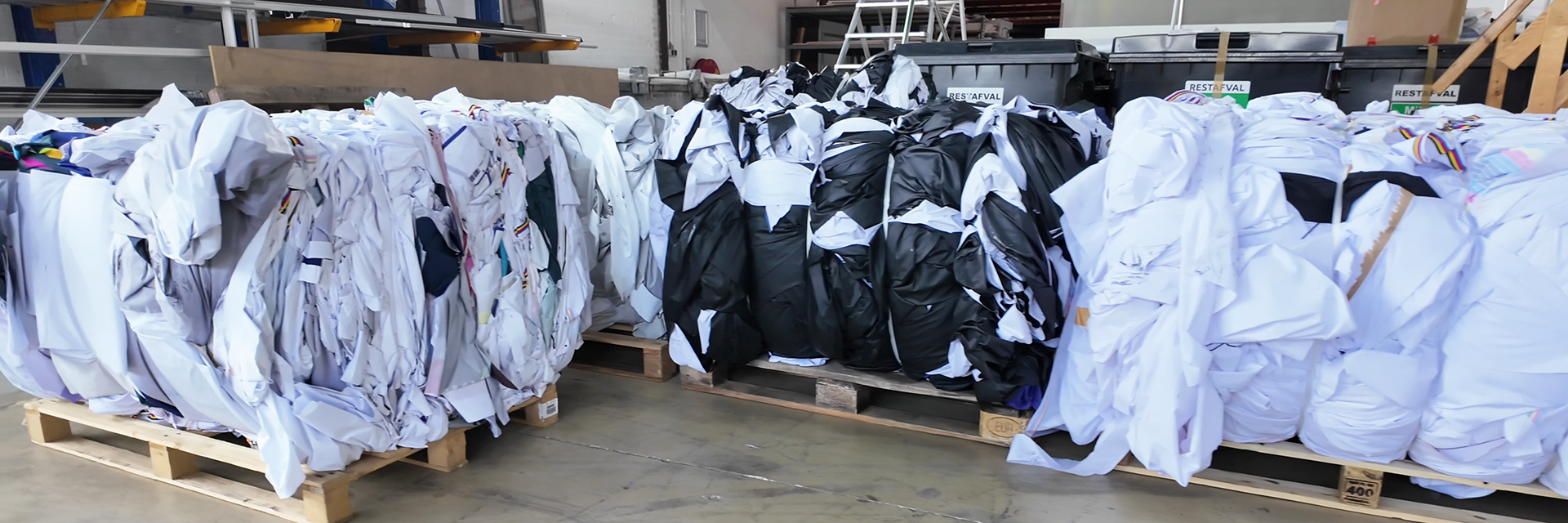
A closed loop for the fabric that reaches end of life. For fabric that has genuinely reached the end of its usable life, our textile recycling programme keeps it out of landfill and gives the material a new purpose. This gives exhibitors a responsible route for the small share of textiles that cannot be reused again, alongside everything that can.
Documentation you can actually use. Because our production process is certified and tracked, including ISO 9001 and ISO 14001, and because we calculate CO2 per order through ClimateCalc, we can support the kind of documentation that a Better Stands pre-assessment or onsite assessment asks for: what the material is, how it was produced, and what happens to it afterwards.
In short, whether you are aiming for Bronze, Silver or Gold, the textile part of your stand does not have to be the weak link. With the right print, the right cutting, and a recycling route for what is left over, your graphics can support a higher rating rather than work against it.
In conclusion
Better Stands is not a requirement, it is an opportunity to make choices you may already be making visible and credible. For exhibitors, the certification can strengthen brand reputation, support ESG reporting, and encourage a more long term approach to exhibition stands.
And for the textile part of the stand specifically, working with a print partner that builds reuse into the fabric itself, the cutting, and the end of life route makes that ambition considerably easier to reach. Read more about the framework at betterstands.org.